
Christmas in the AmberSide Collection
December 14th, 2025 | AmberSide CollectionPhotographic collections often hold the working rhythm of the year, the shifts, streets, households and small routines. Celebrations and rituals matter just as much. They help you see how people try to make life feel warmer, even when the setting is cold, cramped or unpredictable. Christmas is one of the clearest examples. The same gestures repeat across decades and across continents.
Seen together, these images work like a quiet timeline of tradition. They show how people make meaning with whatever they have. They show that celebration sits alongside struggle, not outside it. And they show that marking the end of the year is a constant instinct, whether you are in a North East living room, a Liverpool hostel, an Iowa farmhouse or a New York mission.
Below is a selection of Christmas scenes held in the AmberSide Collection. Each one offers its own version of the season.
“Slumber-time in a mission… it’s Christmas,” c. 1942, by Weegee

Weegee’s photograph, made in a New York mission during the early 1940s, sets a decorated Christmas tree beside a man sleeping on the floor, placing the holiday directly alongside the reality of homelessness. The image sits within Weegee’s wider interest in the parts of the city that mainstream photography ignored, including shelters, night streets and makeshift sleeping spaces. This Christmas scene shows how ritual persists even in environments shaped by scarcity, where the tree holds the only sign of the season and the room reflects the ongoing need for refuge. This photograph recognises that Christmas can be a marker of inequality as much as celebration, and that documenting the day in this setting is part of understanding how people experience public rituals when private security is absent.
Christmas Eve, Hepworths the Tailors, Ashington,1980s by Mik Critchlow

Critchlow’s Ashington work is a long conversation with a mining town and the people whose labour kept it moving. The Hepworths picture sits inside that conversation. It shows Christmas located firmly within industrial work, rather than as a break from it. The festive touch in the factory is slight, yet its very slightness is the point. It reminds us that for many people the ritual of the season is squeezed into the gaps of production, not the other way round.
Scotswood Road, c.1960s, by Jimmy Forsyth

Forsyth’s broader work records a community facing constant change, yet this scene feels steady and domestic. Christmas appears here not through abundance but through arrangement, care and attention to detail. The decorations, the toys and the small tree show how families created ritual inside modest rooms, using what they had to mark the season. It is a reminder that celebration often takes shape in small corners, held together by objects that carry meaning year after year, even as the streets outside shift around them.
Workington & Maryport, c.1985, John Rigby
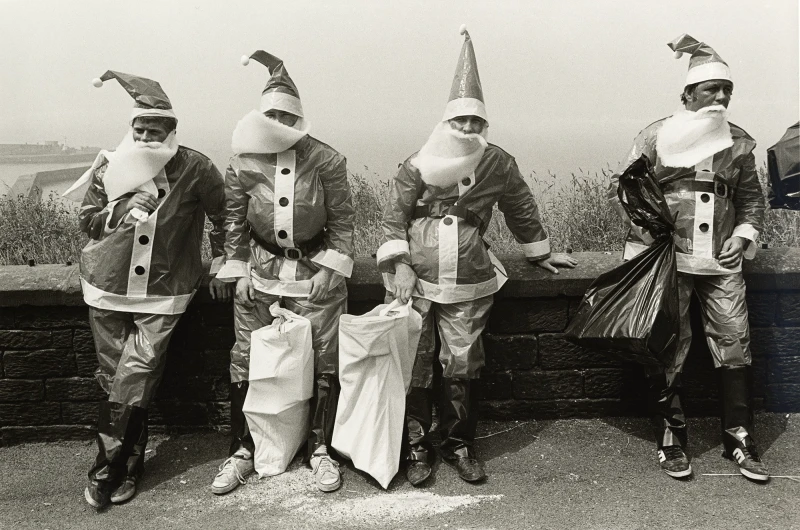
Rigby’s Santas are rooted in Cumbrian coastal towns where public life depends heavily on local effort. The image of several Santas together points to Christmas as something organised between friends, neighbours or workmates. It hints at fundraising, charity events and informal parades, the kinds of activities that rarely enter official histories. Here, seasonal ritual spills onto streets and is stitched into the shared life of the town.
Fathers, Late 1990s, by Peter Fryer

Christmas appears in Fryer’s Fathers series, as the holiday takes shape inside an ordinary room - keeping the season visible and live for children and family. The cards on the wall, the tree set up in the corner, the effort to make it feel like Christmas, all sit within the wider reality of post-industrial Seaham, where traditional forms of work had disappeared but the labour of care had not. Fryer shows fatherhood taking shape through this domestic responsibility, not as a symbolic change but as the practical, everyday work of holding a household together at a time of year when ritual really matters.
Christmas Dinner in Home of Earl Pauley, Near Smithfield, Iowa, 1936, by Russell Lee

Lee photographed the Pauley family’s Christmas dinner while documenting rural poverty for the Farm Security Administration. In this image four children gather around a rough table in a small wooden room. Their meal is plain, made up of potatoes, cabbage and pie, the kind of food that was available to many farm families during the Depression.
The picture shows Christmas as part of everyday survival rather than an interruption to it. There are no decorations, no signs of festivity beyond the fact that this meal was recorded on Christmas Day. Yet the act of preparing and sharing specific foods on that date still marks the occasion. In Lee’s wider body of work, meals often reveal how families held routine together under pressure. Here, Christmas appears as a ritual that continues in reduced form, shaped entirely by what the household has. It becomes a record of persistence rather than celebration, a moment that sits quietly inside the demands of rural life in 1936.
Christmas Day, Petrus Community Hostel, Everton, Liverpool, 1974, by Paul Trevor

Made during Exit Photography Group's wider study of poverty and housing in 1970s Britain, Survival Programmes, this photograph places Christmas inside the routines of communal living. The hostel setting means the holiday is shaped by shared space rather than individual households, and whatever celebration takes place has to fit within that structure. The image shows how a national ritual, broadcast and repeated across the country, lands differently when people are living in temporary or unstable circumstances. Christmas becomes something held together by the room itself, against the backdrop of people gathering in a place designed for day-to-day survival rather than festivity. It highlights how ritual persists, even when the setting is shaped by necessity over comfort.
Seen together, these works show Christmas not as one coherent narrative, but as a series of local solutions to the same question, how to mark time, how to gather, how to make a pause in the year. For AmberSide, holding these moments alongside images of work, struggle and change is part of the point. The collection does not only show what people endured, it also shows how they continued to celebrate, even in small and sometimes fragile ways.
MySide: Ways We Celebrate
We are building a living record of how people mark this time of year, and we want your photographs to be part of it. MySide collects everyday images that show how celebration fits into real life, whether it happens in public, at home, or in the small moments in between. If you have a picture that shows how you and the people around you celebrate, share it with us. Your contribution will sit alongside others from across the region, helping us build a wider picture of the ways communities create meaning, welcome the season, and make time for one another.